
Mileage Correction vs Mileage Clocking: What’s Legal in the UK?
Mileage correction is one of the most misunderstood services in the motor trade. Search for it online and you’ll find conflicting opinions — some call it standard technical practice, others assume it’s always illegal “clocking.” The truth is more precise than either extreme, and knowing the difference matters if you’re considering having it done. Here’s a straight answer, based on UK law and how the process actually works.
What Is Digital Mileage Correction?
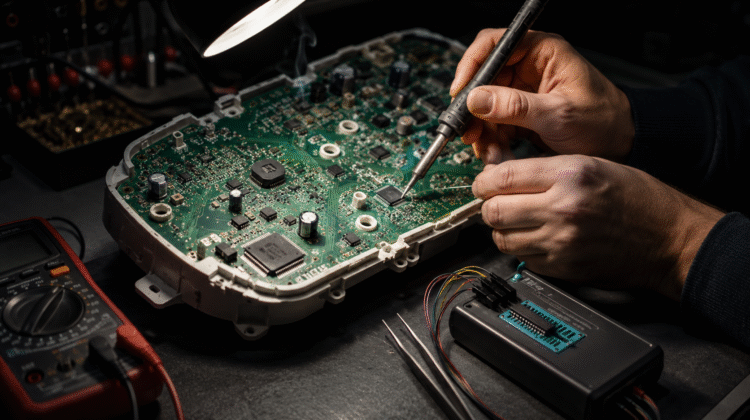
Modern vehicles store mileage data electronically, usually across the instrument cluster, the engine control unit (ECU), and sometimes additional modules such as the ABS system. Digital mileage correction is the process of adjusting this stored data so it accurately reflects the vehicle’s true history.
Depending on the vehicle, this may involve direct communication with the instrument cluster over the OBD-II diagnostic port, or, in more complex cases, physical access to an EEPROM chip inside the cluster itself. Either way, it requires specialist diagnostic equipment and manufacturer-specific knowledge — it isn’t something that can be done with generic tools.
What Do “Mileage Clocking” and “Clocking Back” Mean?
“Clocking” or “clocking back” a car refers to deliberately reducing or falsifying its displayed mileage to misrepresent the vehicle’s true history — typically to inflate its resale value or hide excessive wear. This is completely different from legitimate mileage correction, even though both involve changing what the odometer displays.
The distinction is entirely about purpose. Digital mileage correction restores an accurate figure following a genuine technical fault. Clocking falsifies an accurate figure to deceive a buyer or insurer. One repairs the truth; the other hides it.
Is Mileage Correction Legal?
Yes — mileage correction is legal in the UK when it is carried out to restore an accurate reading following a genuine technical fault or component change. Clocking, on the other hand, is a criminal offence. It falls under UK consumer protection and fraud law, and anyone found to have knowingly sold a vehicle with a falsified mileage — or arranged for one to be clocked — can face prosecution, fines, and a criminal record, alongside civil liability to the buyer.
The Automotive Company only accepts jobs with a genuine, verifiable technical justification. We’re happy to discuss the background to your situation before any work begins, and we decline requests where no legitimate reason exists.
How We Identify Genuine Requests
Because “mileage correction” and “clocking” both involve changing an odometer reading, we take our vetting responsibility seriously — for our customers’ protection as much as our own. Before carrying out any correction, we typically look for:
- A clear, documented reason for the discrepancy — such as a replacement cluster, a diagnosed sensor fault, or evidence of an ECU/module swap
- Consistency with the vehicle’s available service history and MOT mileage record, which you can check for free on the official government website
- A request to correct mileage upward to the accurate figure — not downward without justification, which is a hallmark of clocking rather than correction
- Willingness to provide vehicle documentation and ownership details, rather than insisting on anonymity or cash-only, no-questions-asked terms
If a request doesn’t stack up against these checks, we won’t carry out the work. This isn’t just a policy — it’s what separates a legitimate correction service from the “dodgy” operators that give this trade a bad name.
Legitimate Reasons a Vehicle May Need Mileage Correction
There are several everyday, non-fraudulent situations where a vehicle’s displayed mileage may no longer match its true history:
- Instrument cluster replacement — a replacement dashboard cluster (new or used) will carry its own stored mileage, which won’t match the vehicle’s actual reading
- Speed sensor or ABS sensor failure — a faulty sensor can cause incorrect mileage to be recorded over weeks or months
- ECU or module replacement — swapping any module involved in mileage storage can create a mismatch that needs resolving
- Software faults — some manufacturers have known software bugs that corrupt stored odometer values
- Fleet vehicle refurbishment — fleets occasionally need recalibration following instrument panel servicing or component overhauls
In each of these cases, correction isn’t about hiding anything — it’s about restoring the number that should have been there in the first place.
Why Use a Specialist Rather Than a Main Dealer?
Main dealerships can carry out mileage correction, typically as part of an instrument cluster replacement, but appointments are often slow to book and the cost is significant. The Automotive Company offers dealer-level capability using the same standard of licensed, professional diagnostic equipment — at a considerably more accessible price, and with a mobile service that comes to you rather than the other way around.
Mileage Correction Across the West & East Midlands
We provide mobile digital mileage correction seven days a week across a wide area. See our dedicated pages for more detail on coverage in your area:
- Mileage Correction in Solihull
- Mileage Correction in Birmingham
- Mileage Correction in Manchester
- Mileage Correction in Coventry
- Mileage Correction in Wolverhampton
- Mileage Correction in Leicester
- Mileage Correction in Nottingham
Book Your Mileage Correction
If your vehicle has an inaccurate odometer reading due to a cluster swap, sensor fault, or software issue, we can help — with fast, transparent, and fully legal digital mileage correction wherever you’re based in our coverage area.
Ready to book? Get in touch with us or call 07704 365 247 — we’re available 7 days a week across the UK.
